


Introduction
Today, almost everyone uses social media. People use platforms like Instagram, Facebook, LinkedIn, and YouTube to connect with friends, watch videos, discover new products, and find businesses. This has made social media an important part of modern business growth.
Whether you run a small shop, an educational institution, a startup, or an established company, social media can help you reach more people and build strong relationships with customers.
Social media marketing is not just about posting pictures or uploading videos. It is about reaching the right audience, sharing useful content, building trust, and turning interested people into customers.
At Webingi, we understand that every business wants to grow online without wasting time or money. With the right social media marketing strategy, businesses can improve their online presence, communicate with potential customers, and generate more opportunities.
In this guide, you will learn what social media marketing is, why it matters, which platforms you should use, and how it can help your business grow.
What Is Social Media Marketing?
Social media marketing is the process of promoting a business, product, service, or brand through social media platforms.
It includes creating posts, sharing videos, publishing stories, running advertisements, replying to comments, and interacting with customers online.
For example, if you own a clothing store, you can post pictures of your latest collection on Instagram. If you run a school, you can share student activities, school events, and admission updates on Facebook. If you provide professional services, you can use LinkedIn to connect with potential clients.
The main goal is to help people discover your business and understand how your products or services can solve their problems.
Social media marketing generally includes two approaches:
- Organic social media marketing: Posting content and building an audience without paying for each post’s distribution.
- Paid social media marketing: Running advertisements to reach selected audiences based on factors such as location, interests, and demographics.
A successful strategy often combines both approaches according to the business’s goals and budget.
Why Is Social Media Marketing Important for Your Business?
Customers often search online before choosing a product or service. They may check your Instagram profile, read Facebook reviews, watch your videos, or visit your website before contacting you.
If your business has a strong social media presence, potential customers can learn more about your brand and feel more confident about contacting you.
Here are some important benefits of social media marketing.
1. Builds Brand Awareness
Brand awareness means helping more people recognise and remember your business.
Regular posting, useful information, engaging videos, and consistent branding can make your business more familiar to your target audience.
For example, a digital marketing agency can share SEO tips, website improvement ideas, and social media marketing advice. Over time, people may begin to recognise the agency as a helpful source of information.
2. Helps You Reach the Right Audience
Social media platforms offer different ways to reach people who may be interested in your services.
With organic content, you can attract people through relevant topics, hashtags, shares, and recommendations. With paid advertising, you can select audiences using available targeting options.
For a local business, location-focused content can be particularly useful. For example, a service provider in Indore can create content for customers searching for digital marketing services in Indore.
3. Builds Trust With Customers
People are more likely to consider a business when they can understand what it offers and see evidence of its work.
You can build trust by sharing customer feedback, project examples, educational posts, behind-the-scenes content, and clear information about your services.
Avoid making promises you cannot support. Honest communication and consistent service help create stronger customer relationships.
4. Generates Leads and Enquiries
Social media can help turn interested viewers into potential customers.
You can encourage people to visit your website, send a direct message, fill out an enquiry form, or contact your business through WhatsApp where appropriate.
For example, a digital marketing agency can publish a post explaining how businesses can improve their online visibility and invite interested readers to request a consultation.
5. Supports Website Traffic
Social media posts can introduce people to your website and encourage them to explore your services, read your blogs, or contact your team.
Sharing useful blog articles is also a way to connect your social media activity with your website content.
However, traffic alone does not guarantee sales. Your website should clearly explain your services, provide contact details, and make it easy for visitors to take the next step.
6. Provides Measurable Results
Most major social media platforms provide performance data.
You can measure reach, engagement, video views, profile visits, website clicks, enquiries, and other relevant actions.
This information helps you understand which content works best and where your marketing efforts need improvement.
Which Social Media Platf
orms Are Best for Your Business?
Every social media platform has a different audience and purpose. You do not need to use every platform. The best choice depends on your customers, services, budget, and business goals.
Instagram Marketing
Instagram is useful for businesses that can communicate through photos, short videos, Stories, and visual content.
It can work well for fashion brands, restaurants, beauty services, educational institutions, local businesses, and digital marketing agencies.
You can share:
- Reels explaining your products or services.
- Customer testimonials and project results.
- Tips, tutorials, and educational content.
- Stories featuring offers, updates, and frequently asked questions.
Facebook Marketing
Facebook can help businesses connect with local communities and share updates, photos, videos, events, and offers.
It may be particularly useful for local service providers, educational institutions, retailers, and businesses with an established Facebook audience.
Facebook advertising can also help eligible businesses reach selected audiences, depending on their campaign settings and available targeting options.
LinkedIn Marketing
LinkedIn is especially useful for professional networking and business-to-business marketing.
Companies can share industry knowledge, case studies, company updates, professional insights, and service information.
For a digital marketing agency, LinkedIn can help build relationships with business owners, marketing managers, and other professionals.
YouTube Marketing
YouTube is suitable for businesses that want to explain topics in more detail through videos.
You can create tutorials, product demonstrations, educational videos, customer stories, and answers to common questions.
Helpful videos may continue attracting viewers long after publication, although results depend on audience interest, video quality, and discoverability.
WhatsApp Business
WhatsApp Business can support customer communication, service enquiries, product information, and follow-ups.
Businesses can use it to respond to customer questions and share relevant updates with people who have agreed to receive them.
Always respect customer privacy and avoid sending unwanted promotional messages.
How to Create an Effective Social Media Marketing Strategy
Posting randomly is not a reliable way to grow your business. A clear strategy helps you focus on the activities that support your goals.
Step 1: Define Your Business Goals
Start by deciding what you want to achieve.
Your goals may include:
- Increasing brand awareness.
- Getting more website visitors.
- Generating customer enquiries.
- Promoting a new product or service.
- Improving customer engagement.
- Increasing qualified sales opportunities.
Choose goals that can be measured. For example, instead of saying, “I want more customers,” you could aim to increase qualified enquiries through social media over the next three months.
Step 2: Understand Your Target Audience
Your target audience includes the people most likely to need your products or services.
Consider their age group, location, interests, common problems, purchasing habits, and preferred platforms.
For example, if you provide digital marketing services to schools, your audience may include school owners, principals, admission teams, and education administrators.
Understanding your audience helps you create content that answers their actual questions.
Step 3: Create Valuable Content
Content is one of the most important parts of social media marketing.
Instead of only promoting your services, share information that helps your audience make better decisions.
Useful content ideas include:
- Educational tips and simple guides.
- Frequently asked questions.
- Customer success stories with permission.
- Service explanations.
- Common mistakes and their solutions.
- Short videos demonstrating your expertise.
- Industry updates and practical advice.
A helpful content strategy balances educational, engaging, trust-building, and promotional posts.
Step 4: Maintain a Consistent Posting Schedule
Consistency helps your audience know what to expect from your business.
Create a content calendar that lists the topic, platform, format, and planned publication date for each post.
For example, you might publish educational tips on Monday, a short video on Wednesday, and a service-related post on Friday. Adjust the schedule to your available resources and audience response.
Quality and relevance are more important than publishing a large number of low-value posts.
Step 5: Engage With Your Audience
Social media works best when communication goes both ways.
Reply to relevant comments, answer direct messages, acknowledge feedback, and address customer questions politely.
These interactions help you understand your audience and make your business more approachable.
If someone asks about pricing or services, provide clear information rather than sending repeated generic promotional messages.
Step 6: Use Paid Advertising Carefully
Paid social media campaigns can help you reach audiences beyond your existing followers.
Before spending money, define your campaign objective, audience, budget, advertisement, and desired action.
For example, a local business might run an enquiry campaign targeting relevant customers in its service area.
Start with a manageable budget, monitor the results, and make changes based on actual performance. Do not assume that more advertising spend automatically means more sales.
Step 7: Track Performance and Improve
Review your results regularly to understand what is working.
Important metrics may include:
- Reach: The number of unique accounts that saw your content.
- Engagement: Interactions such as likes, comments, saves, and shares.
- Click-through rate: The percentage of impressions that resulted in clicks.
- Cost per lead: The advertising cost associated with generating a lead.
- Conversion rate: The percentage of relevant visitors or leads who complete a desired action.
The right metrics depend on your objectives. For example, a brand awareness campaign should not be judged in exactly the same way as a lead-generation campaign.
How Social Media Marketing Helps Small Businesses
Small businesses often have limited budgets and small teams. Social media gives them a practical way to communicate with potential customers and share their expertise.
A local bakery can post new products and seasonal offers. A coaching centre can share learning tips and course information. A real estate company can publish property walkthroughs. A digital marketing agency can explain how SEO and online advertising support business growth.
These examples show that social media marketing is not limited to large brands.
Small businesses can begin with a clear profile, useful content, regular communication, and a simple performance-tracking process.
The key is to focus on the audience most relevant to your business instead of trying to reach everyone.
Common Social Media Marketing Mistakes to Avoid
Even businesses that post regularly can struggle if their strategy is unclear.
Here are some common mistakes to avoid:
1. Posting without a plan: Random posts may fail to communicate a consistent brand message. Create a content calendar around your goals.
2. Focusing only on sales: Constant promotional messages can make your content less useful. Educate and engage your audience as well.
3. Ignoring comments and messages: Slow or unclear responses can cause potential customers to lose interest.
4. Buying fake followers: Fake followers do not represent genuine customer interest and can make performance data less useful.
5. Copying competitors: Learn from other businesses, but create content that reflects your own services, experience, and customer needs.
6. Expecting immediate results: Building trust and generating consistent enquiries can take time. Review progress regularly instead of judging your strategy after only a few posts.
7. Ignoring analytics: Without reviewing performance, you may continue investing effort in content that does not support your goals.
Why Choose Webingi for Social Media Marketing?
Choosing the right digital marketing partner can make it easier to plan and manage your online presence.
At Webingi, our focus is on helping businesses understand digital marketing in a simple and practical way. A social media strategy should reflect your business goals, target audience, services, and available budget.
A professional social media marketing plan may include content planning, creative development, profile optimisation, audience engagement, advertising support, and performance reporting, depending on the services agreed upon.
The aim is to create a consistent brand presence and identify opportunities to attract relevant audiences and generate meaningful enquiries.
If you are planning to improve your social media presence, start by identifying your main business goal and the customers you want to reach. A clear plan can help you make better decisions and use your marketing resources more effectively.
Frequently Asked Questions About Social Media Marketing
1. What is social media marketing in simple words?
Social media marketing means promoting your business on platforms such as Instagram, Facebook, LinkedIn, and YouTube to connect with potential customers, share useful information, and support business growth.
2. Why is social media marketing important for businesses?
It can help businesses increase brand awareness, communicate with customers, share their expertise, attract website visitors, and generate enquiries.
Results depend on the quality of the strategy, audience, content, budget, and business offering.
3. Which social media platform is best for business?
There is no single best platform for every business. Instagram may suit visual brands, LinkedIn can be useful for B2B services, YouTube works well for educational videos, and Facebook can support local community engagement.
Choose platforms based on where your target audience spends time.
4. Is social media marketing free?
Creating an account and publishing organic posts can be free. However, marketing still requires time and effort. Professional content creation, social media management, tools, and paid advertising may involve additional costs.
5. How often should a business post on social media?
The ideal frequency depends on your platform, audience, content quality, and resources. Start with a realistic schedule that you can maintain consistently, then use performance data to improve it.
6. How long does social media marketing take to show results?
Some posts may generate engagement quickly, but building brand recognition, trust, and consistent enquiries usually requires ongoing work. The timeline varies by business, industry, competition, and strategy.
7. Can social media marketing help generate leads?
Yes. Businesses can use relevant content, advertisements, website links, enquiry forms, and direct messages to encourage potential customers to make contact.
Tracking lead quality and conversions helps determine whether the strategy is effective.
8. What is the difference between social media marketing and digital marketing?
Digital marketing is the broader term for promoting a business through online channels, including SEO, paid search, email marketing, websites, and social media. Social media marketing is one part of digital marketing.
9. Should small businesses invest in social media marketing?
Social media can be valuable for small businesses when it helps them reach relevant customers and supports clear business goals. Start with suitable platforms, useful content, and a manageable budget.
10. How can I get started with social media marketing?
Define your goals, understand your audience, select the right platforms, create a content plan, engage with customers, and measure your results. If needed, work with a professional digital marketing agency to develop a strategy suited to your business.
Conclusion
Social media marketing has become an important tool for businesses that want to build an online presence and connect with customers.
From creating brand awareness to sharing useful content and generating enquiries, it offers several ways to support business growth. However, success requires more than simply posting every day. Businesses need a clear strategy, relevant content, consistent communication, and regular performance reviews.
Whether you run a small business, an educational institution, a startup, or a professional service, you can begin by understanding your audience and choosing the platforms that best match your goals.
Ready to improve your online presence? Explore the digital marketing services offered by Webingi and identify the right next step for your business.
A thoughtful social media strategy can help your business communicate more effectively, build trust, and create opportunities for long-term growth.
SEO Details for This Blog
SEO Meta Title: Social Media Marketing: A Complete Guide for Businesses
Meta Description: Learn how social media marketing helps businesses build brand awareness, reach customers, generate leads, and grow online with practical strategies.
Focus Keyword: Social Media Marketing
Secondary Keywords:
- Social media marketing services
- Social media marketing strategy
- Social media marketing for small businesses
- Social media management
- Social media advertising
- Digital marketing services
- Online business promotion
Suggested URL Slug: /social-media-marketing-guide/
Suggested Blog Tags: Social Media Marketing, Digital Marketing, Instagram Marketing, Facebook Marketing, Social Media Strategy, Online Business Growth
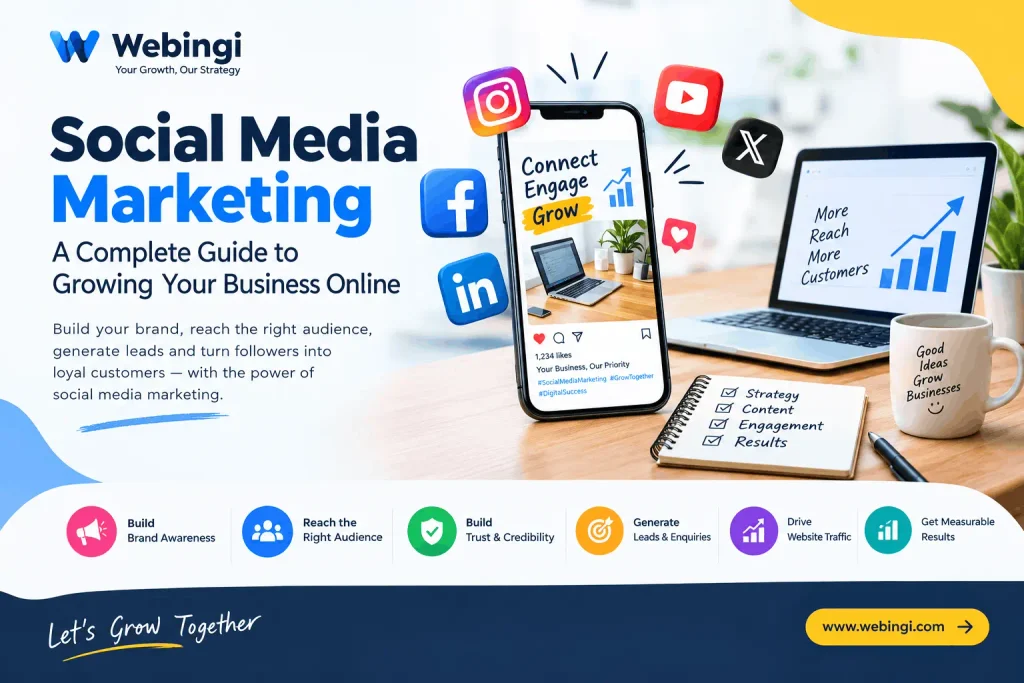
Suggested Featured Image Alt Text: Social media marketing strategy for business growth
Suggested Internal Links:
- Digital Marketing Services
- Search Engine Optimization (SEO)
- Website Design and Development
- Google Ads Management
- Contact Webingi
Add these internal links only where the relevant pages exist on your website.
Content Quality Note: This article is written to support SEO, answer common customer questions, and provide useful, easy-to-understand information. Search rankings are not guaranteed. Before publishing, review the content against Webingi’s actual services and add genuine client examples, relevant experience, and verifiable results wherever available.